
Here's something I wish someone had told me when I first sat down to meditate: the most valuable moment in your meditation is not the one where you're focused. It's the one where you catch yourself not being focused.
That sounds wrong. It felt wrong to me for years. I'd sit, follow my breath, notice after three minutes that I'd been planning dinner, and feel like I'd failed. Again. The inner monologue was predictable: You can't even follow your breath for sixty seconds. What's wrong with you?
It turns out that what I was calling failure was the whole point. And there's a body of research that explains exactly why.
Your mind wanders — and you don't know it
In 2002, cognitive scientist Jonathan Schooler at UC Santa Barbara published a paper that helped how many of us think about meditation. He made a simple but profound distinction between three levels of mental processing.
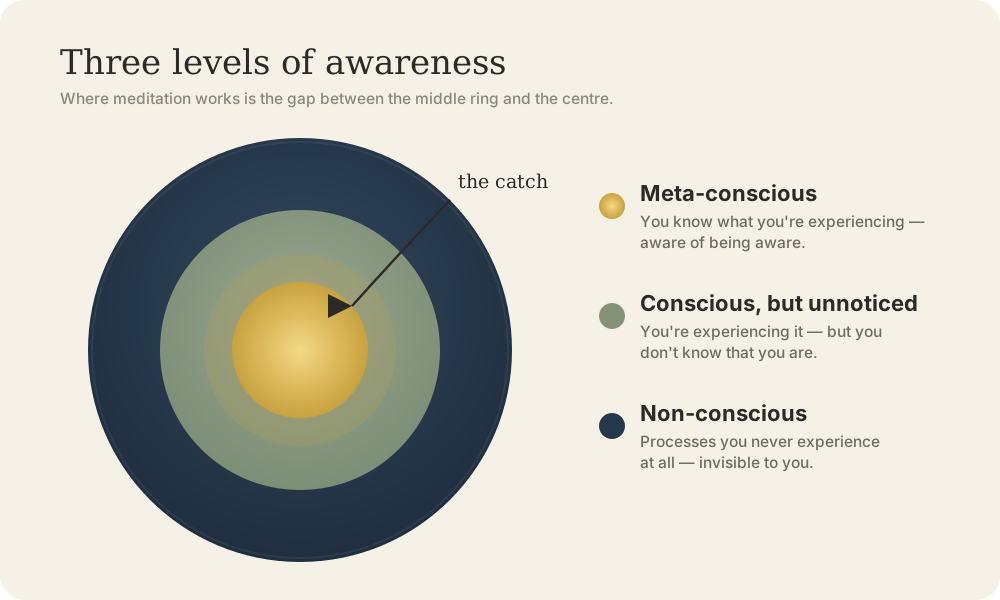
The first is non-conscious: processes you never experience at all, like the neural calculations adjusting your pupils to light. You have no access to them.
The second is conscious: experiences you have — but without necessarily knowing you're having them. This is the crucial one.
The third is meta-conscious: experiences where you explicitly know what you're experiencing. You're aware of being aware.
The insight that matters for meditation is the gap between the second and third levels. You can be conscious of something — a thought, a daydream, a worry — without being meta-conscious of it. You're thinking, and you know what you are thinking about. So you are conscious. But you don't know that you are thinking. You're experiencing the thought, but you are not aware that what is happening is that there is a thought, and you are engaging with it. Instead it is more like, that you just are the thought. .
This isn't mystical. Schooler demonstrated it empirically. In reading studies, participants were frequently caught mind-wandering, wandering they hadn't noticed themselves, but which they confirmed was a conscious experience when asked. They were thinking. They just didn't know they were thinking.
That's exactly what happens on the cushion
Sit with me through a typical meditation:
Phase 1. You settle in. You find your breath. You know you're following your breath. This is meta-consciousness in action — you're aware of what your attention is doing.
Phase 2. Gradually, a thought arises. Maybe a memory, maybe tomorrow's meeting, maybe a song lyric. The thought is conscious — you're experiencing it — but meta-consciousness has gone dark. You don't know you've left the breath. You're absorbed in the content without noticing the absorption. You are somehow identified with the thought.
This is the moment that is very familiar to all experienced meditators: the breath has slipped out of awareness and into, well, unawareness. Not because it disappeared, but because another conscious process took the foreground, and the part of you that monitors what you're attending to went with that thought, went kind of offline.
Phase 3. Then — often with a little jolt — you catch yourself. "Oh. I was thinking about dinner." Meta-consciousness comes back online. You see that you weren't seeing.
That third moment? That's where the training happens.
Why the catch is the practice
Every time you catch yourself, you're doing something specific and measurable: you're closing the gap between consciousness and meta-consciousness. You're training your brain to notice its own state — to light up, more frequently and more quickly, with awareness of what it's actually doing.
Wendy Hasenkamp and colleagues put meditators in an MRI scanner and identified four phases that cycle during meditation: focus (on the breath), mind wandering (drift away), awareness (catching the drift), and shifting (returning to the breath). Each phase activates distinct brain networks. The awareness phase — the catch — activates the salience network, the brain's alarm system for noticing that something important has changed.
Over time, with practice, meditators show a measurable change: the gap between wandering and catching gets shorter. Not because the mind stops wandering — it doesn't, not really — but because the catch comes faster. The internal light flickers on sooner.
That's not a metaphor. It's neuroplasticity. Each catch is a rep.
The reframe that changes everything
So here's the reframe: you didn't fail because your mind wandered. You succeeded because you noticed.
If your mind wandered and you didn't notice — if you spent the whole session lost in thought without a single moment of catching — that would be a less productive session (though still not a failure; the habit of sitting matters too). But the moment you catch yourself? That's a micro-moment of awakening. A tiny flash of the light that Jung was talking about when he said enlightenment is not imagining figures of light, but making the darkness conscious.
Every catch is a moment of making the darkness conscious! Every return is a moment of choosing where to place your attention. And every gentle return — "ah, there I was again, that's fine, back to the breath" — is a moment of training self-compassion alongside meta-awareness.
Which brings me to the other half of this: how you come back matters as much as that you come back.
The quality of the return
Kristin Neff's research on self-compassion shows that self-criticism after a setback activates the body's stress response — cortisol, sympathetic nervous system, fight-or-flight. Self-compassion does the opposite: it activates the parasympathetic system, calms the body, and makes it easier to re-engage with the thing you were doing.
Applied to meditation: if you catch yourself wandering and react with "I'm hopeless, I can't focus" — that's a stress response. It makes the next few minutes of meditation harder, not easier. Your body tenses. Your mind tightens.
If you catch yourself and respond with "ah, there I was — back to the breath" — that's self-compassion. It keeps the body calm and the mind open. And critically, it trains the quality of mind you'll bring to the next catch, and the next, and the hundreds after that.
Over thousands of repetitions, that difference shapes something fundamental: not just your meditation, but the basic stance from which you meet your own mind. Hard and critical, or warm and clear. Both notice the wandering. Only one makes the noticing sustainable.
What this means for practice
A few practical things follow from all this:
Celebrate the catch. Not with a parade, but with a quiet internal nod. You noticed. Good. That's the point.
Don't count wanderings as failures. Count them as reps. Each one is a cycle of the attention circuit that Hasenkamp mapped. Focus, wander, catch, return. That cycle is the workout.
Keep sessions short enough to stay fresh. The 9th Karmapa, a Tibetan meditation master from the 16th century, said it plainly: "Make your sessions short and many. Stop while the clarity is still fresh." Modern research on micro-breaks and cognitive performance backs this up: frequent short sessions maintain attention quality better than long, grinding ones. If your mind is wandering every five seconds and you're just suffering through twenty minutes — shorten the session, take a breath, start again fresh.
Bring the catching with you. The meta-awareness you train in meditation doesn't stay on the cushion. Over time, you'll start catching yourself in daily life — mid-irritation, mid-worry, mid-autopilot. Those catches are the same muscle. They open the same small space of choice between stimulus and response.
And bring the compassion with you. The care and compassion you meet yourself with, and meet yourself with againg and againg, will also caring on. It will, over time, become the way you meet all aspects of your self with, and also leak into the way you meet others.
The bottom line
Meditation isn't about achieving a thought-free state. It's about developing the capacity to notice what your mind is doing — and to meet that noticing with warmth rather than judgment.
The science is clear: the gap between conscious experience and meta-conscious awareness is real, measurable, and trainable. Every time you sit and catch yourself wandering, you're training it. Every gentle return is a rep. And the accumulation of those reps, over weeks and months, changes something real — in your brain, in your relationship to your own mind, to yourself and to others, and in the quiet moments of your daily life where you suddenly notice you have a choice you didn't know you had.
So the next time you catch yourself three minutes into a meditation, deep in a fantasy about lunch: smile. You just did the thing.